
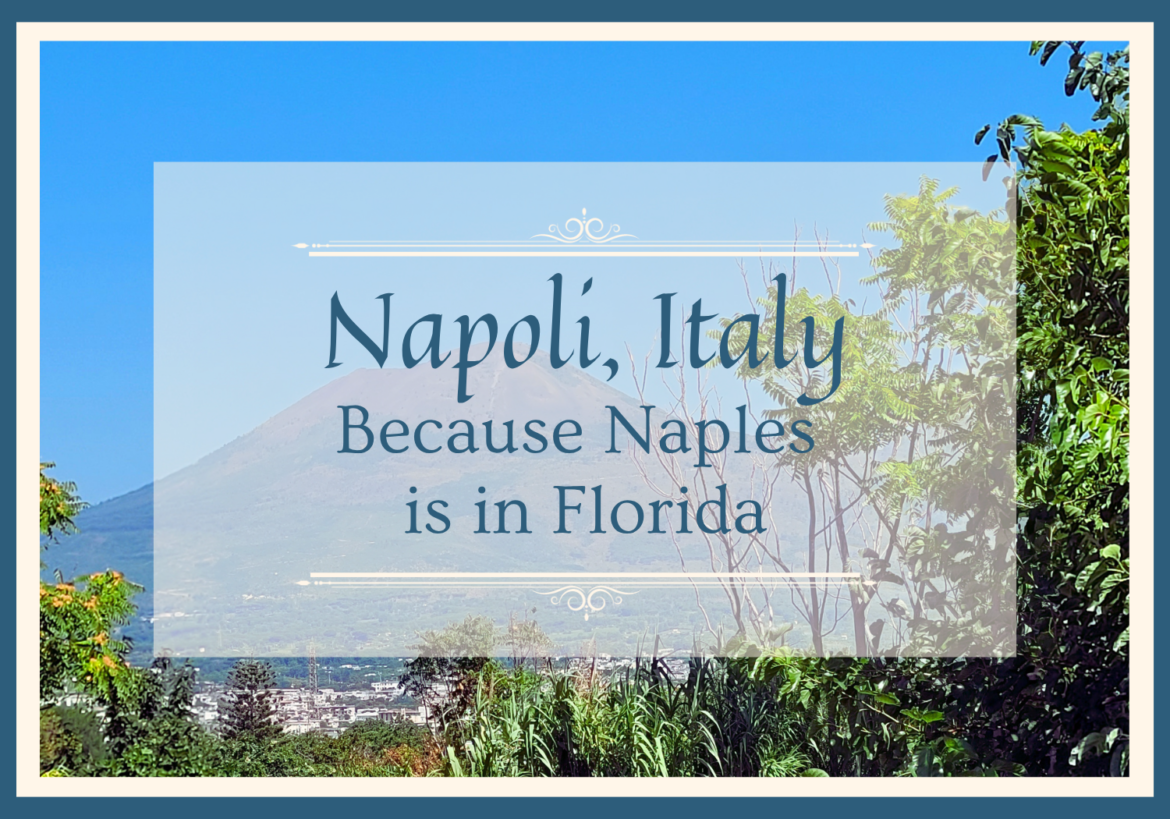

First things first: Napoli and Naples are the same city. I’ll use the names interchangeably throughout this article because, well, that’s how people actually talk about the city. And yes, I know the difference.
I also know that if I simply say “Naples,” my Napoleonic tour guide Vincenzo would be very upset.
So, for the sake of avoiding confusion: We’re talking about Napoli. Italy.
And if you happen to be a history nerd, food lover, or traveler who likes a destination with a little personality (and perhaps a little chaos), Naples deserves a spot on your Italy itinerary.
More Than 2,500 Years of History in Napoli
Napoli isn’t just old. It’s really old.
The city’s history reaches back to the Greek settlements of the ancient Mediterranean. The earliest settlement was known as Parthenope, traditionally associated with the 9th century BC. Later, Greek settlers established Neapolis, meaning “new city,” around 470 BC. UNESCO recognizes this Greek foundation as an important part of the historic city’s extraordinary cultural layers.
And those layers are still visible today.
That is one of the things I found most fascinating about Naples. You aren’t walking through a city that has carefully preserved one particular period of its history. Instead, you’re walking through the accumulated remains of thousands of years of people, cultures, religions, governments, wars, and artistic movements.
The Greeks were followed by the Romans, and Naples became an important cultural center within the Roman world. Over the centuries, the city came under the influence of Byzantine, Norman, Angevin, Aragonese, Spanish, and Bourbon rulers before becoming part of unified Italy.
Each left something behind.
Architecture changed. Languages and customs evolved. Food traditions absorbed new ingredients and techniques. Churches and palaces were built, altered, abandoned, and repurposed.
In other words, Naples is history that never really stopped happening.And you can see it.
Look Closely at the Architecture
One of my favorite things about traveling is looking beyond the obvious attraction. In Naples, that can mean looking up.
Walk through the historic center and you’ll find churches, palaces, narrow streets, archaeological remains, elaborate facades, worn stone, colorful laundry, and modern life all occupying the same space.
It can feel chaotic, but there’s a reason for that chaos.
Napoli has spent centuries being shaped by different cultures and rulers. UNESCO describes the historic city as retaining the imprint of successive cultures from the ancient Greek Neapolis through modern times.
That makes Naples especially rewarding for travelers interested in history and anthropology.
Instead of asking, “What period does this building represent?” you can ask, “What happened here, and what came before it?”Sometimes the answer spans centuries.
Naples During World War II
The city’s complicated history doesn’t stop with ancient Greece or the Roman Empire.
Naples was heavily damaged during World War II, and the destruction became another layer in the city’s story. More than 200 Allied air raids struck the city during the war, devastating neighborhoods and destroying or damaging thousands of buildings. The destruction wasn’t simply something Naples rebuilt and forgot. In some places, the scars of the war became part of the city’s historical landscape.
In fact, some archaeological discoveries in Naples are directly connected to wartime destruction. The city notes that Roman remains at the Terme di Carminiello ai Mannesi were uncovered during the clearing of rubble from an air raid.
Think about that for a moment.
A bomb destroys part of a modern city, and beneath the rubble, archaeologists discover evidence of a city that existed nearly 2,000 years earlier.
That is Naples in a nutshell. The past isn’t buried neatly behind glass. Sometimes you find it underneath the street you’re standing on.
There’s Pizza!
Let’s be honest. You can give me all the history in the world, and I’m still going to talk about the pizza. Napoli has some of the best pizza I’ve ever eaten.
Actually, let me be more specific…I dream about this stuff.
This pizza isn’t quite the same experience as grabbing a slice back home. Traditional Neapolitan pizza is made from a relatively simple dough and cooked at extremely high temperatures in a wood-fired oven, producing the characteristic soft center and puffy, lightly charred edge.
And then there’s the Margherita Pizza.
The traditional story says that in 1889, pizza maker Raffaele Esposito created a pizza honoring Queen Margherita of Savoy during her visit to the region, using tomatoes, mozzarella, and basil to represent the colors of the Italian flag.
It’s a great story—and one that has become deeply connected with the identity of Neapolitan pizza. UNESCO’s documentation also notes that this is the commonly accepted tradition, while acknowledging the historical nature of the story.
Whether every detail of the legend is historically accurate or not, one thing is NOT debatable:
You should eat pizza in Naples.
And if you really love food experiences, don’t just make a reservation at a famous pizzeria. Take a pizza-making class. Learn how the dough is prepared, watch the pizzaiolo work, and then try making your own. You may never look at pizza night the same way again.
Food tours are another great option, particularly if you’re the kind of traveler who plans vacations around what you’re going to eat. No judgment here.
Beyond Pompeii: Unique Things to Do Around Naples
Pompeii gets most of the attention…and deservedly so. But one of my biggest travel recommendations for Napoli is to look beyond the most famous attraction.
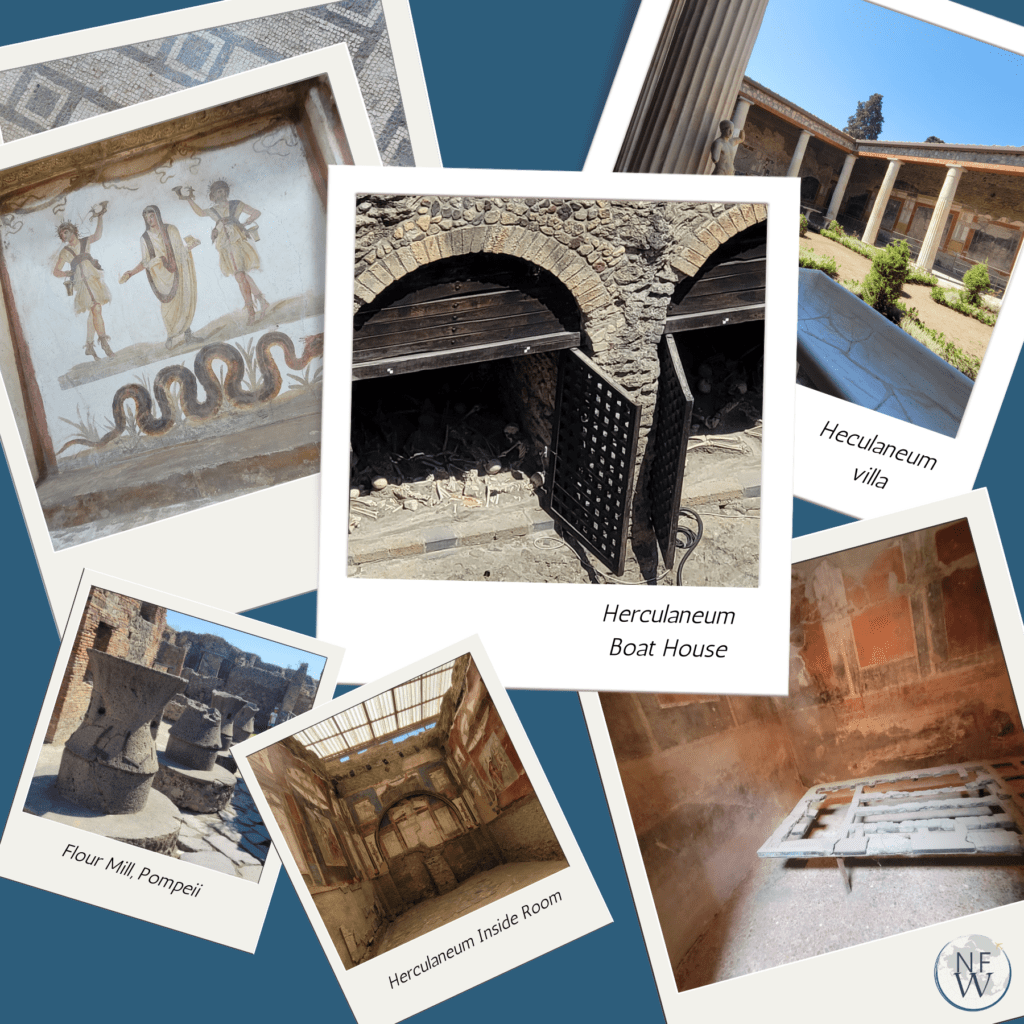
Visit Herculaneum
If Pompeii is on your Italy itinerary, consider adding Herculaneum.
The two ancient cities were both destroyed by the eruption of Mount Vesuvius in AD 79, but their experiences of the eruption and the archaeological remains are different.
Herculaneum is smaller than Pompeii, which can make it feel more manageable if you don’t have an entire day to devote to an archaeological site.
If you have enough time, visiting both is ideal. If you don’t, I’d seriously consider giving Herculaneum a chance instead of automatically following the crowds to Pompeii.
Climb Mount Vesuvius
And then there’s the volcano.
Mount Vesuvius is one of the most recognizable landmarks surrounding Naples and remains an active volcano, although it is closely monitored.
Standing on or near Vesuvius is an experience that feels a little different when you know what happened here in AD 79. The eruption buried Pompeii and Herculaneum and permanently altered the landscape.
Today, you can hike toward the crater and look across the Bay of Naples, with the archaeological sites and surrounding communities spread below. For the adventurous traveler, horseback-riding excursions around Vesuvius can also offer another way to experience the landscape.
Just remember: this isn’t merely a scenic mountain. It’s a volcano. Respect the rules, follow local guidance, and pay attention to official alerts.
Step Into the Charterhouse of San Martino
The Certosa di San Martino, or Charterhouse of San Martino, is another fascinating stop for history lovers.
The former Carthusian monastery dates back to the 14th century and contains beautiful cloisters, artwork, and historic spaces. One of its most remarkable treasures is the enormous Cuciniello Nativity Scene, containing hundreds of figures and objects.
And then there’s the view.
The charterhouse sits high above the city, offering an incredible panorama of Naples and the Bay of Naples. It’s one of those places where the history is worth the visit, but the view makes you want to stay awhile.
Explore Underwater History in Pozzuoli
If regular archaeological sites aren’t adventurous enough for you, head toward Pozzuoli.
The area is known for archaeological remains that extend into the sea, including the submerged Roman ruins of Baia. You can explore the underwater archaeological park by diving or, depending on current offerings, through boat or submarine-style excursions.
It’s a pretty spectacular reminder that history doesn’t always stay where we leave it. Sometimes the sea gets it.
Escape to Ischia or Procida
Naples is a fantastic base for exploring some of the islands in the Bay of Naples.
Take a ferry to Ischia or Procida for a completely different pace. Think colorful buildings climbing the hillsides, Mediterranean views, small streets, seaside restaurants, and enough photographic opportunities to keep your camera busy.
After navigating the energy of Naples, an island day can feel like hitting the reset button.
Procida in particular can be a wonderful choice if you’re looking for somewhere quieter and less polished than some of Italy’s better-known coastal destinations.
Is Naples Safe?
Before my trip, I heard plenty of opinions about Naples. And almost none of them were positive.
When I told people that Napoli was part of my Italy itinerary, I heard warnings about crime, pickpockets, and how unsafe the city supposedly was.
I always take travel safety seriously, so I wasn’t about to ignore those warnings. But I also wasn’t going to let someone else’s perception determine my experience.
During my visit, I found the people of Naples to be some of the friendliest and most welcoming people I encountered in Italy.
That doesn’t mean you should throw common sense out the window.
Keep an eye on your belongings. Be aware of your surroundings. Avoid wandering into unfamiliar areas late at night simply because you want to see what happens. Use the same precautions you would use in any major city.
But don’t assume that every person who approaches you is looking to steal your wallet, either.
I also noticed that Naples felt like one of the most diverse places I visited in Italy. That made me reflect on some of the warnings I’d heard before my trip. Were all of the negative perceptions I encountered based purely on concerns about crime and safety?
I can’t answer that for anyone else. But I can say that my experience was considerably more welcoming than the reputation I had been given.
Come prepared. Be aware. And then actually experience the city for yourself.
Stay Somewhere With a Story
If you’re anything like me, a hotel isn’t just a place to sleep. I love staying somewhere that adds another layer to the trip.
Because Naples has such a long history, historic accommodations aren’t hard to find. Within the city, consider looking into places such as Palazzo Doria Napoli or Artemisia Domus-Giardino.
Staying in a historic building can make your trip feel like an extension of the destination rather than simply a place where you happen to keep your suitcase. And that’s particularly fitting in Naples.
Why stay in a generic hotel when you can sleep inside the history you’re there to explore?
Consider Caserta Instead
If the energy of Naples sounds a little overwhelming, there’s another option. Caserta.
Located outside Naples, Caserta can provide a quieter base while still keeping you within reach of many of the region’s major attractions.
And there’s one enormous reason history lovers should consider it: The Royal Palace of Caserta.
The Reggia di Caserta is one of the most spectacular royal residences in Europe, with enormous gardens, elaborate interiors, and a history tied to the Bourbon monarchy. If you love European palaces, put this one on your radar.
And if you really want to lean into the royal experience, you can take it one step further and stay in a castle.
Castello di Limatola dates back to the medieval period and offers the kind of setting that makes “hotel” feel like a serious understatement.
Because sometimes, a travel itinerary needs a castle.
Why Napoli Belongs on Your Italy Itinerary
Naples isn’t polished in the same way as Florence.
It doesn’t feel like Rome.
It isn’t trying to be Venice.
And that’s precisely why I think it’s worth visiting.
Naples is loud, layered, historic, delicious, complicated, beautiful, and occasionally chaotic.
It has Greek foundations beneath Roman ruins, medieval monasteries overlooking a modern city, palaces built by foreign rulers, neighborhoods shaped by war, and a food culture that has become famous around the world.
It has a volcano looming over the bay.
It has islands offshore.
It has archaeological sites beneath modern streets.
And it has pizza that I still think about.
But perhaps my favorite thing about Naples is that you can see how the past and present coexist.
You don’t have to go looking for history. Just walk outside.
Look up. Look down. Look behind the next doorway.
And pay attention.
Because in Napoli, history isn’t simply something you visit.
It’s something you walk through.
Check out articles about other Italy Travel Destination: Milan, Florence, or Rome!
While the author generated the ideas and research, portions of this article were improved using Grammarly and ChatGPT.

